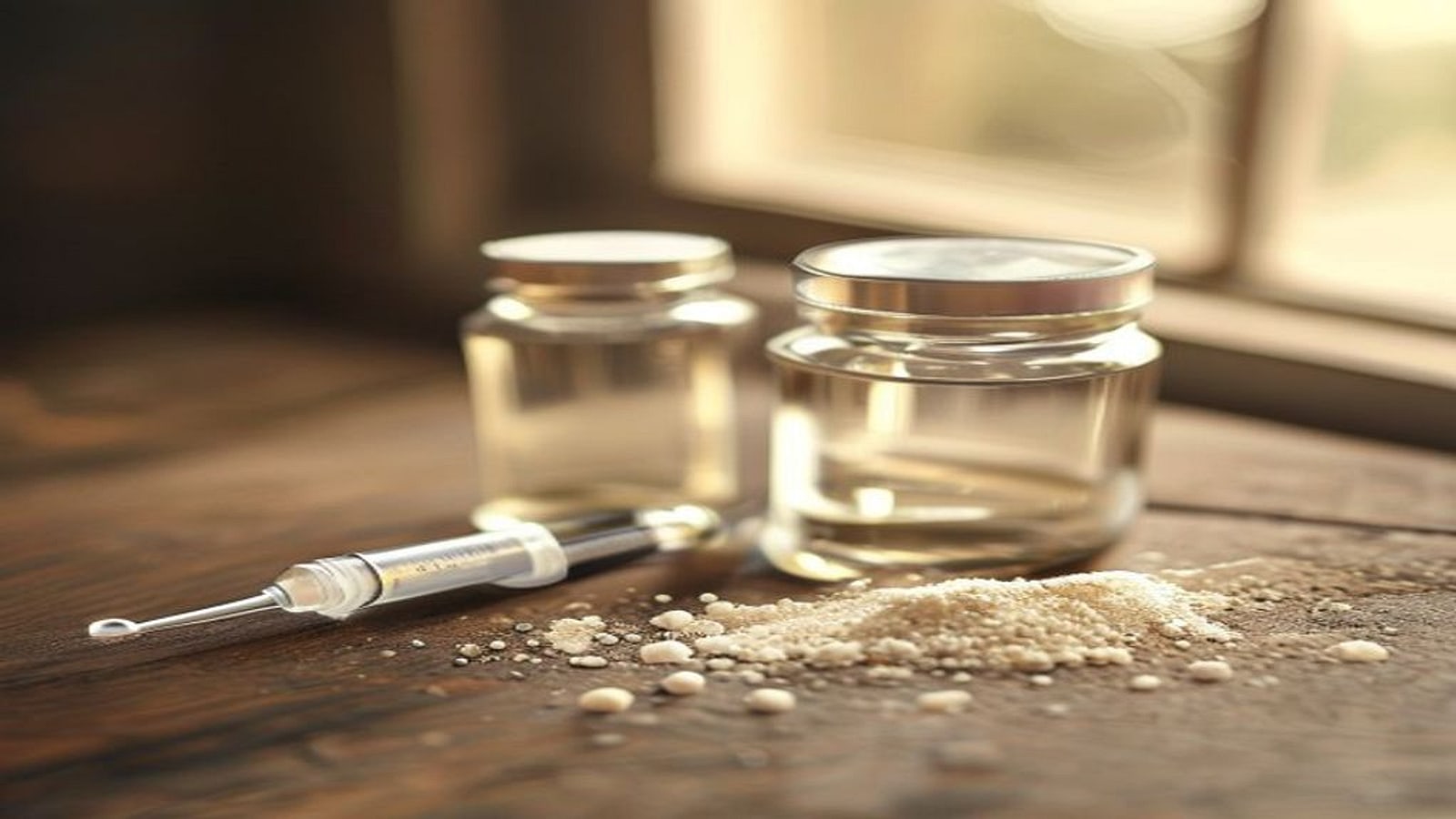
A lyophilized peptide is the white-to-off-white pellet sitting at the bottom of the vial after the manufacturer freeze-dried the water out of it. Dry, the reagent stays stable for months, but you can't actually work with it until you bring it back to a liquid. That step is called reconstitution. Below is a thorough walk-through of how to reconstitute peptides with bacteriostatic water, how to run the concentration math, and how to draw the volume you want on an insulin syringe. Everything here is about handling a laboratory reagent — it is not human-use guidance.
What peptide reconstitution is, and why it matters
Peptide reconstitution means dissolving the dry powder in a sterile diluent until you have a clear liquid of known concentration. The peptide ships dry because in water it slowly hydrolyzes and degrades; under vacuum at low temperature the molecule holds its structure far longer. When you need the reagent, you reconstitute it yourself — and that's exactly the step where people ruin material with avoidable mistakes.
One thing to lock in early: the amount of peptide in the vial is fixed. If it's 5 mg, it stays 5 mg no matter how much water you add. Water only changes the concentration — how many milligrams sit in each milliliter of liquid. The volume you pick decides how fine your dose graduations are and how comfortably the draw lands on a syringe.
Bacteriostatic water vs. sterile water vs. saline
The diluent isn't a throwaway detail. The standard for peptides is bacteriostatic water (BAC water): water for injection with 0.9% benzyl alcohol added. The benzyl alcohol suppresses bacterial growth, so an opened vial keeps in the fridge for weeks instead of hours.
- Bacteriostatic water — water + 0.9% benzyl alcohol. The preservative holds back contamination after the first puncture, which makes it the right pick for a multi-use vial.
- Sterile water for injection — plain water, no preservative. Fine for a single use, but once you've broken the seal you use it right away; there's nothing protecting it from bacteria.
- Saline (0.9% NaCl) — a salt solution. Some peptides precipitate or go cloudy in it, so it's not the go-to for most reagents, and the salt gives you no bacteriostatic protection either.
In practice: if you plan to stretch a vial across weeks, use bacteriostatic water. Save sterile water for the cases where the whole volume gets used in one go.
What you'll need
- Your vial of lyophilized peptide.
- A vial of bacteriostatic water.
- Sterile syringes. A 1–3 ml syringe is handy for adding the water; a U-100 insulin syringe (1 ml / 100 units) is what you draw the dose with.
- Alcohol swabs (70% isopropyl) for wiping the rubber stoppers.
- A clean flat surface and washed hands. No cleanroom required, but no clutter and grime either.
Step-by-step reconstitution
- Let both vials reach room temperature. If the peptide or the water came out of the fridge, give them time to warm up. Cold glass and sudden temperature swings help nothing, and dissolution goes more evenly at room temp.
- Swab both stoppers. Run an alcohol swab over the rubber stopper of the peptide vial and the water vial. Let it dry for ten seconds or so.
- Draw the water. Puncture the bacteriostatic water vial and pull your calculated volume (the math is below). You don't have to invert the vial, but keep the needle tip in the liquid, not in the air pocket.
- Add the water slowly, down the glass wall. This is the part that matters most. Tilt the peptide vial, rest the needle against the inner glass wall, and release the water in a thin stream so it runs down the side rather than blasting straight into the powder. A jet aimed at the pellet shears the molecule and foams it — don't do that.
- Don't shake — swirl. Let the vial sit for a minute, then gently rotate it between your fingers in slow circles. Some peptides dissolve on their own in a couple of minutes; others take ten to fifteen. Shaking and foam are the number-one enemy: bubbles mean denaturation.
- Wait for full dissolution. A finished solution should be clear and free of flakes. Cloudiness, sediment, or undissolved bits is a reason to question the reagent or the diluent.
A small tip from doing this a lot: if powder clings to the side wall, don't shake it loose — just tilt the vial so the liquid covers it and let it sit. Patience is cheaper than a wasted vial.
How to calculate the concentration
The math rests on a single equation:
Concentration (mg/ml) = peptide mass (mg) ÷ water volume (ml)
A few worked examples:
- 5 mg peptide + 2 ml water → 5 ÷ 2 = 2.5 mg/ml.
- 10 mg peptide + 2 ml water → 10 ÷ 2 = 5 mg/ml.
- 5 mg peptide + 1 ml water → 5 ÷ 1 = 5 mg/ml (more concentrated, finer graduations).
The rule of thumb: more water means a lower concentration and more accurate draws of tiny volumes; less water means a higher concentration and a more economical spread across the syringe. If you'd rather not do it by hand, run it through our peptide reconstitution calculator — it gives you the concentration, the draw volume in ml, and the reading in syringe units at once.
Reading the dose on a U-100 insulin syringe
An insulin syringe is marked in units, not milliliters, which trips up newcomers. The relationship to memorize:
1 ml = 100 units on a U-100 syringe. So 0.1 ml = 10 units, and 0.5 ml = 50 units.
Let's run a concrete one. A 5 mg vial reconstituted with 2 ml of water gives 2.5 mg/ml. Say the protocol calls for drawing 0.25 mg of the reagent.
- Volume in ml: 0.25 mg ÷ 2.5 mg/ml = 0.1 ml.
- Convert to syringe units: 0.1 ml × 100 = 10 units.
So you fill to the "10" mark on the insulin syringe. The logic never changes: divide the mass you want by the concentration to get ml, then multiply by 100 to get the syringe graduation.
How to reconstitute specific peptides: worked examples for popular reagents
The formula is the same for everything, but vials differ in mass, so the concentration and the syringe graduations come out differently. Below are ready-made calculations for the fast-movers in our catalog. The numbers are an example of handling a laboratory reagent, not a use protocol.
How to reconstitute Semaglutide
Semaglutide is stocked in 5 mg and 10 mg vials. Take our Semaglutide 5 mg and reconstitute it with 2 ml of bacteriostatic water: 5 ÷ 2 = 2.5 mg/ml. If the work calls for drawing 0.25 mg of reagent, the math is 0.25 ÷ 2.5 = 0.1 ml — that's 10 units on a U-100 syringe. With the 10 mg vial and the same 2 ml you get twice the concentration, 5 mg/ml, and the same mass lands at just 5 units. Finer graduations are easier to read when you need precision.
How to reconstitute Tirzepatide
Tirzepatide ships in a 10 mg vial. Take Tirzepatide 10 mg and add 2 ml of water: 10 ÷ 2 = 5 mg/ml. To draw 0.5 mg of reagent, 0.5 ÷ 5 = 0.1 ml — that's 10 units on the insulin syringe. Want a finer spread? Reconstitute with 3–4 ml instead: the concentration drops, the same mass stretches over more units, and drawing small volumes gets more accurate.
How to reconstitute Retatrutide
Retatrutide comes in a 5 mg vial. For Retatrutide 5 mg, dissolve the powder in 2 ml of water: 5 ÷ 2 = 2.5 mg/ml. Drawing 0.5 mg of reagent: 0.5 ÷ 2.5 = 0.2 ml, i.e. 20 units on a U-100 syringe. As a triple agonist it's the newest and priciest reagent in the line, so careful reconstitution is especially worthwhile here.
A quick word on BPC-157 and TB-500
The healing peptides follow the same logic. BPC-157 5 mg reconstitutes cleanly in 2.5 ml of water → 2 mg/ml; drawing 0.25 mg = 0.125 ml = 12.5 units. TB-500 10 mg in 5 ml of water also gives 2 mg/ml, and 0.5 mg of reagent is 0.25 ml = 25 units. The larger diluent volume isn't a problem here: the vials hold more, and the lower concentration makes for a more accurate draw.
Don't feel like doing the math for your own vial? Drop the mass and volume into our reconstitution calculator and it returns the concentration and syringe graduations in a second.
Storing reconstituted peptide
- Keep it at 2–8 °C. A regular fridge shelf, not the door (the door temperature swings).
- Don't freeze it. Freezing and re-thawing wrecks most peptides. The dry lyophilized powder can live in the freezer; the reconstituted solution can't.
- Keep it out of the light. Park the vial in its box or an opaque container.
- Shelf life after reconstitution. With bacteriostatic water, most peptides stay usable for a few weeks (a 3–4 week window gets quoted a lot) given clean handling. With preservative-free sterile water, treat it as single-use.
Common mistakes
- Shaking the vial instead of swirling it — foam and denaturation.
- Squirting water straight into the powder — mechanical damage to the pellet.
- Saline or tap water in place of bacteriostatic water — sediment, cloudiness, contamination.
- Confusing ml with syringe units — the single most common arithmetic slip.
- Storing the vial in the fridge door, or freezing the finished solution.
- Working with dirty hands or skipping the alcohol swab on the stopper.
FAQ
How much bacteriostatic water do I add to a vial?
Whatever gives you a convenient concentration — 1–2 ml per vial is typical. Remember that the water changes only the concentration, never the amount of peptide. Our calculator will pin the exact number for your case.
Can I reconstitute a peptide with regular or distilled water?
No. Without a preservative and sterility control the solution contaminates fast, and some peptides dissolve poorly. The standard is bacteriostatic water.
Why can't I shake the vial?
Peptides are fragile molecules. Vigorous shaking and air bubbles break their structure (denaturation). Always swirl gently.
How long does reconstituted peptide last?
On bacteriostatic water, refrigerated at 2–8 °C, usually a few weeks. On preservative-free sterile water, treat it as a single use.
What do the units on an insulin syringe mean?
A U-100 syringe is marked so that 1 ml = 100 units. Work out the volume in ml first (mass ÷ concentration), then multiply by 100 to get the graduations.
Ready to pick a reagent for your research? Browse the peptide catalog under GLP-1 / GIP — including Semaglutide, Tirzepatide and Retatrutide — or the full range. Every batch ships with a certificate of analysis.
Everything above concerns handling a laboratory reagent and is intended strictly for research purposes. Not for human use.